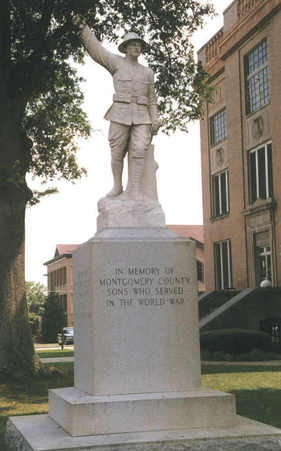
Photo: The Doughboy Center Website
http://www.worldwar1.com/dbc/monument.htm
Contributed by Peter Koch, Mountain Heritage Center
Western Carolina University.
http://www.worldwar1.com/dbc/monument.htm
Contributed by Peter Koch, Mountain Heritage Center
Western Carolina University.
TROY, NORTH CAROLINA
N 35° 21.514 / W 79° 53.558
Copyright year unknown, stone or "marble", unsigned.
Smithsonian Art Inventory Control Number: NC000264.
Copyright year unknown, stone or "marble", unsigned.
Smithsonian Art Inventory Control Number: NC000264.

In front of Montgomery County Courthouse, at intersection of South Pearl and East Main Streets.

The inscription on the front of the pedestal reads:
IN MEMORY OF
MONTGOMERY COUNTY
SONS WHO SERVED
IN THE WORLD WAR
The inscription on the proper right side of the pedestal reads:
IN MEMORY OF
MONTGOMERY COUNTY
SONS WHO SERVED
IN THE SPANISH AMERICAN WAR
The inscription on the proper left side of the pedestal reads:
IN MEMORY OF
MONTGOMERY COUNTY
WOMEN
WHO DID THEIR PART
IN ALL WARS
IN MEMORY OF
MONTGOMERY COUNTY
SONS WHO SERVED
IN THE WORLD WAR
The inscription on the proper right side of the pedestal reads:
IN MEMORY OF
MONTGOMERY COUNTY
SONS WHO SERVED
IN THE SPANISH AMERICAN WAR
The inscription on the proper left side of the pedestal reads:
IN MEMORY OF
MONTGOMERY COUNTY
WOMEN
WHO DID THEIR PART
IN ALL WARS

Dedicated May 1, 1926.
This is one of five known stone designs similar to Viquesney's "Spirit of the American Doughboy" but which lacks the gas mask pouch, backpack, and canteen. They are all thought to have been made by McNeel Marble Company of Marietta, Georgia, and at least one was misrepresented as a Viquesney Doughboy in a sales pitch to the town of Clarksville, Tennessee.
This is one of five known stone designs similar to Viquesney's "Spirit of the American Doughboy" but which lacks the gas mask pouch, backpack, and canteen. They are all thought to have been made by McNeel Marble Company of Marietta, Georgia, and at least one was misrepresented as a Viquesney Doughboy in a sales pitch to the town of Clarksville, Tennessee.

Links:
flickr.com
flickr.com
