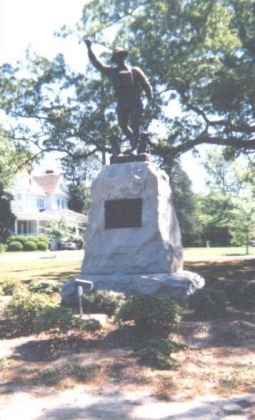
 The Doughboy in 1999, missing left hand and rifle. |
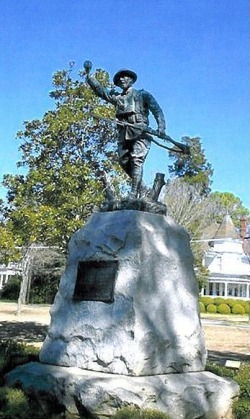 The Doughboy in 2004, restored. Photo: Pamela Smith, Clanton Alabama. |
AMERICUS, GEORGIA
(where Viquesney created the Doughboy)
N 32° 03.959 / W 084° 13.485
Copyright version 1920, sheet bronze.
Smithsonian Art Inventory Control Number: 47260012.
Copyright version 1920, sheet bronze.
Smithsonian Art Inventory Control Number: 47260012.

In the southeast part of Rees Park, bordered on the north by Taylor Street, the west by Elm Street and the east by Rees Street.

The inscription on the plaque reads:
SUMTER COUNTY
AFFECTIONATELY REMEMBERS
HER SONS WHO DIED, AND THOSE
WHO OFFERED THEMSELVES, AS
WILLING SACRIFICES IN THE
CAUSE OF OUR COUNTRY.
1917 WORLD WAR 1918
SUMTER COUNTY
AFFECTIONATELY REMEMBERS
HER SONS WHO DIED, AND THOSE
WHO OFFERED THEMSELVES, AS
WILLING SACRIFICES IN THE
CAUSE OF OUR COUNTRY.
1917 WORLD WAR 1918

Originally dedicated November 11, 1921, at the intersection of Lee and Lamar Streets. Viquesney was present but had no role in the ceremony. The statue was moved to Rees Park in 1947, and now stands about two blocks from Viquesney's residence in 1920, according to Facebook visitor Evan Kützler. It isn't the original Doughboy; that one was placed at Nashville, Georgia in July or August 1921, and it isn't the first to be permanently placed on public display; that one was dedicated on the Furman University campus at Greenville, South Carolina June 7, 1921.
The left hand, rifle and bayonet were replaced in a 1995 project to refurbish Rees Park memorials, but had been dislodged again by the time the left photo above was taken in 1999. They were replaced again by the time the right photo was taken in March 2004.
The statue stood almost directly in the path of the devastating F3 tornado that struck Americus on March 1, 2007. Miraculously, it survived unscathed, while foot-thick trees around it were snapped in half like toothpicks.
The statue is on the National Register of Historic Places.
The left hand, rifle and bayonet were replaced in a 1995 project to refurbish Rees Park memorials, but had been dislodged again by the time the left photo above was taken in 1999. They were replaced again by the time the right photo was taken in March 2004.
The statue stood almost directly in the path of the devastating F3 tornado that struck Americus on March 1, 2007. Miraculously, it survived unscathed, while foot-thick trees around it were snapped in half like toothpicks.
The statue is on the National Register of Historic Places.
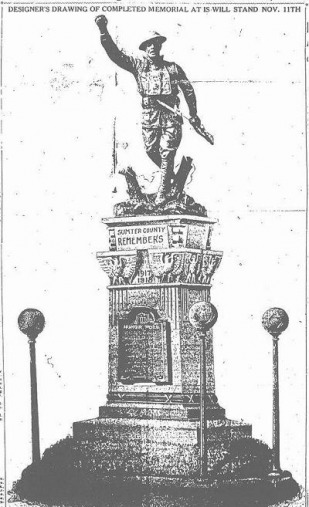 Above: The Americus Times-Recorder published Viquesney’s own drawing of an ornate pedestal under the statue shortly before its November 11, 1921 dedication. The printing across the top of the picture reads; “DESIGNER’S DRAWING OF COMPLETED MEMORIAL AT IS [sic] WILL STAND NOV. 11”. However, the photo at right, showing the original dedication, shows the same base that is present today.
|
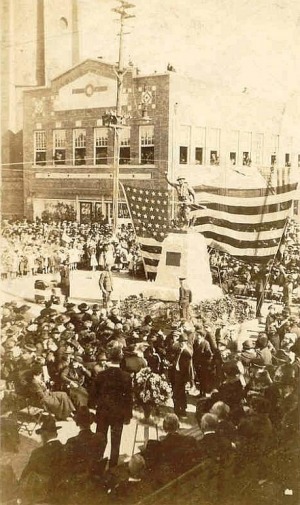 Above: photo of the original unveiling of the Doughboy at Lee and Lamar Streets. Thanks to Alan Anderson and the Sumter Historic Trust, Inc., for the photo. See Mr. Anderson's Viquesney biography and chronology on our Viquesney Archive website. Alan's office is in the same room where Viquesney's miniature Doughboys were first produced, formerly a Ford dealership once owned by Viquesney's friend and business partner Walter Rylander. The building is now headquarters of Habitat for Humanity.
|
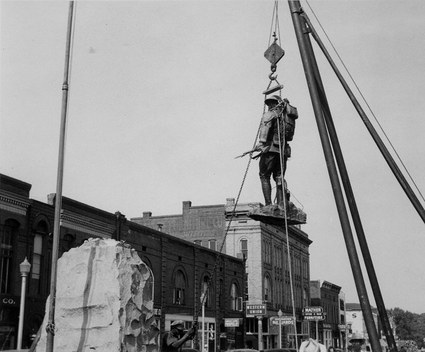
The July, 1947 move from the intersection of Lee and Lamar Streets.
Photo courtesy of Sumter Historic Trust, Inc., from the collection of Mike Saliba.
Photo courtesy of Sumter Historic Trust, Inc., from the collection of Mike Saliba.
E. M. Viquesney came to Americus, GA, in 1905 to work on the large Civil War monuments in the area, first employed by Clark's Monument Works and later Schneider Marble Company. In 1911, he designed the building and vault for the Soldiers and Sailors Monument (completed in 1913) that stands in Wichita, KS, and in 1919, he invented a new type of above-ground burial vault, patented the following year.
But it was in 1920 that Viquesney copyrighted what would become his most famous work, "The Spirit of the American Doughboy". After the first statue was completed and put on temporary display in the lobby of the Rylander Theatre in March of 1921, public interest was great enough so that the following June Viquesney began producing a miniature 12-inch desktop version which became popular, particularly among the veterans who had recently returned home from the World War.
However, possibly in response to a 1922 lawsuit on behalf of rival sculptor John Paulding, Viquesney, who had only just begun his new Doughboy venture, sold the entire company to his business partner, Walter Rylander, the owner of the Rylander Theatre and Ford auto dealership building next door to it. Mr. Rylander subsequently owned the rights to the Doughboy for four years before returning the company to Viquesney in January of 1926. Throughout the time Rylander owned the rights to the Doughboy, he produced some of the desktop miniatures in a back room of his auto dealership building. Rylander had plans to shut down production of the miniatures from factories in the northwest and concentrate their manufacture in Americus, but Viquesney was able to buy back his company before this could happen.
But it was in 1920 that Viquesney copyrighted what would become his most famous work, "The Spirit of the American Doughboy". After the first statue was completed and put on temporary display in the lobby of the Rylander Theatre in March of 1921, public interest was great enough so that the following June Viquesney began producing a miniature 12-inch desktop version which became popular, particularly among the veterans who had recently returned home from the World War.
However, possibly in response to a 1922 lawsuit on behalf of rival sculptor John Paulding, Viquesney, who had only just begun his new Doughboy venture, sold the entire company to his business partner, Walter Rylander, the owner of the Rylander Theatre and Ford auto dealership building next door to it. Mr. Rylander subsequently owned the rights to the Doughboy for four years before returning the company to Viquesney in January of 1926. Throughout the time Rylander owned the rights to the Doughboy, he produced some of the desktop miniatures in a back room of his auto dealership building. Rylander had plans to shut down production of the miniatures from factories in the northwest and concentrate their manufacture in Americus, but Viquesney was able to buy back his company before this could happen.

