 Photos:
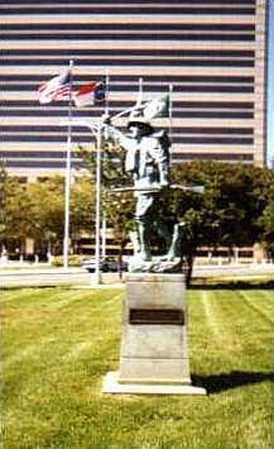
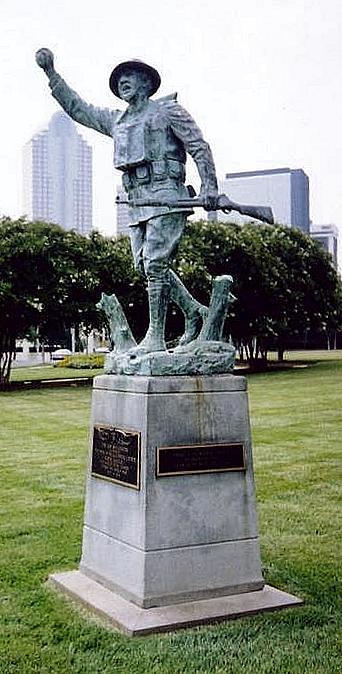
Above: Suzanne Sink, Charlotte, North Carolina. Right: Kerrie Carter, Charlotte, North Carolina. |
|
CHARLOTTE, NORTH CAROLINA
N 35° 13.298 / W 080° 50.326
Copyright version 1920, sheet bronze.
Smithsonian Art Inventory Control Number: NO ENTRY.
Copyright version 1920, sheet bronze.
Smithsonian Art Inventory Control Number: NO ENTRY.

Dedicated May 30, 1923, at old county courthouse on South Tryon Street. Rededicated November 11, 1928 after being moved to North Kings Drive near Park Center (now Grady Cole Center). Moved again in June, 1975 to present location on City Hall lawn a few yards in from the corner of South Alexander and East 4th Street.

Plaque inscriptions on the front and rear of the base read:
Front:
FOR GOD AND COUNTRY
IN HONOR OF
THE MEN OF MECKLENBURG COUNTY,
NORTH CAROLINA
WHO SERVED THEIR COUNTY
DURING THE WORLD WAR
1917 - 1919
Rear:
THIS MEMORIAL
ERECTED BY
CITIZENS OF THIS COMMUNITY
IN APPRECIATION OF
WAR SERVICE IN THE CAUSE
OF WORLD-LIBERTY AND JUSTICE
Inscriptions on the Doughboy’s left and right read:
THERE IS NO HIGHER SERVICE
TO ONE’S COUNTRY
THAN DUTY WITH THE FLAG
and
THEIR MANHOOD PREVAILED:
THEIR CAUSE TRIUMPHED.
Front:
FOR GOD AND COUNTRY
IN HONOR OF
THE MEN OF MECKLENBURG COUNTY,
NORTH CAROLINA
WHO SERVED THEIR COUNTY
DURING THE WORLD WAR
1917 - 1919
Rear:
THIS MEMORIAL
ERECTED BY
CITIZENS OF THIS COMMUNITY
IN APPRECIATION OF
WAR SERVICE IN THE CAUSE
OF WORLD-LIBERTY AND JUSTICE
Inscriptions on the Doughboy’s left and right read:
THERE IS NO HIGHER SERVICE
TO ONE’S COUNTRY
THAN DUTY WITH THE FLAG
and
THEIR MANHOOD PREVAILED:
THEIR CAUSE TRIUMPHED.

Several articles in the Charlotte News from October, 1922, mention an upcoming installation by the Mecklenburg Council of the American Legion. The Legion's Hornets' Nest Post Number 9 raised the money for the statue, known locally for years as "Johnny Doughboy".
According to Commemorative Landcapes, "this statue was purchased by C.O. Kuester of his own volition on the belief that Charlotte needed a memorial to the men of Charlotte and Mecklenburg County that had served in World War One. He had seen the statue at the 1922 Made-in-Carolinas Exposition held in Charlotte at the booth of the Charlotte Marble and Granite Works. He purchased it with his own funds and after the fact solicited public subscriptions to cover the costs." It should be noted, however, that the statue itself was not "made in Carolinas"; it was manufactured by the Friedley-Voshardt Company of Chicago, Illinois. What C. O. Kuester saw displayed at the exposition was the "made in Carolinas" stone base with the made in Chicago statue mounted on it.
Information provided by Charlotte resident Jay Clontz states that, the statue's second location on Kings Drive was near the old Central High School which had its last classes in 1959. Afflicted by polio as a child, Jay reports he used to stop and rest on a ledge on the statue's pedestal while on the way to and from school in the early 1950s. It was in an inverted "V" island at the North Cecil Street entrance to the American Legion Memorial Stadium area via Park Drive. Cecil Street no longer exists in that area - it has roughly been replaced by Kings Drive. The statue was moved to its current location in June of 1975. The Doughboy was restored that year, and while the bayonet, rifle sling and barbed wire are missing, is in relatively satisfactory condition. The statue has been painted a brownish color since the above photos were taken.
The minutes of the December 14, 2009 meeting of the Charlotte-Mecklenburg Historical Landmarks Commission stated there were plans to move the statue back to "a prominent place at American Legion Memorial Stadium" but according to a January 30, 2016 Charlotte Observer news article posted by the paper's librarian, Maria David, the statue is still at the City Hall location.This statue was purchased by C.O. Kuester of his own volition on the belief that Charlotte needed a memorial to the men of Charlotte and Mecklenburg County that had served in World War One. He had seen the statue at the 1922 Made-in-Carolinas Exposition held in Charlotte at the booth of the Charlotte Marble and Granite Works. He purchased it with his own funds and after the fact solicited public subscriptions to cover the costs.
According to Commemorative Landcapes, "this statue was purchased by C.O. Kuester of his own volition on the belief that Charlotte needed a memorial to the men of Charlotte and Mecklenburg County that had served in World War One. He had seen the statue at the 1922 Made-in-Carolinas Exposition held in Charlotte at the booth of the Charlotte Marble and Granite Works. He purchased it with his own funds and after the fact solicited public subscriptions to cover the costs." It should be noted, however, that the statue itself was not "made in Carolinas"; it was manufactured by the Friedley-Voshardt Company of Chicago, Illinois. What C. O. Kuester saw displayed at the exposition was the "made in Carolinas" stone base with the made in Chicago statue mounted on it.
Information provided by Charlotte resident Jay Clontz states that, the statue's second location on Kings Drive was near the old Central High School which had its last classes in 1959. Afflicted by polio as a child, Jay reports he used to stop and rest on a ledge on the statue's pedestal while on the way to and from school in the early 1950s. It was in an inverted "V" island at the North Cecil Street entrance to the American Legion Memorial Stadium area via Park Drive. Cecil Street no longer exists in that area - it has roughly been replaced by Kings Drive. The statue was moved to its current location in June of 1975. The Doughboy was restored that year, and while the bayonet, rifle sling and barbed wire are missing, is in relatively satisfactory condition. The statue has been painted a brownish color since the above photos were taken.
The minutes of the December 14, 2009 meeting of the Charlotte-Mecklenburg Historical Landmarks Commission stated there were plans to move the statue back to "a prominent place at American Legion Memorial Stadium" but according to a January 30, 2016 Charlotte Observer news article posted by the paper's librarian, Maria David, the statue is still at the City Hall location.This statue was purchased by C.O. Kuester of his own volition on the belief that Charlotte needed a memorial to the men of Charlotte and Mecklenburg County that had served in World War One. He had seen the statue at the 1922 Made-in-Carolinas Exposition held in Charlotte at the booth of the Charlotte Marble and Granite Works. He purchased it with his own funds and after the fact solicited public subscriptions to cover the costs.

