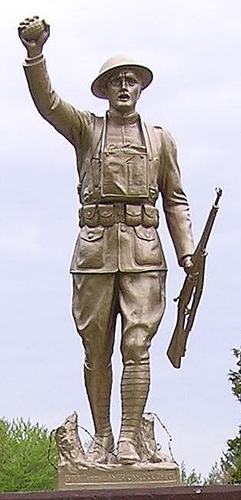
Peshtigo, Wisconsin
1934: THE CAST ZINC DOUGHBOYS
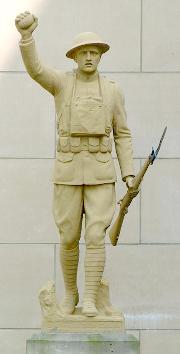
Akron, Ohio
Things couldn't have been worse for Viquesney in 1933: His first wife, Cora, died that year, and at the bottom of the Great Depression, for the first time since production began in 1921, he didn't sell a single copy of his flagship "Spirit of the American Doughboy" statue.
Picking up the pieces, in mid-1934 Viquesney revised the design of the sculpture, making the tree stumps on the base shorter, and the figure more slender-looking. This had the effect of making the statue appear taller. At this time, he abandoned Friedley-Voshardt, the company that made the sheet bronze statues, in favor of Raphael Groppi Studio, and changed the construction method to cheaper cast zinc, which allowed him to offer his new Doughboy at the bargain-basement price of $700 each. They were also available in a greater variety of finishes from the new manufacturer.
The strategy worked somewhat. Sales began to pick up, but never to the degree Viquesney had achieved previously: From 1934 on, until production ended in 1942, only 23 of these zinc Doughboys were fabricated, which amounts to less than one fifth of the total sold between 1921 and 1932.
Despite the existence of these zinc versions, many websites such as Wikipedia continue to describe all Viquesney Doughboys as "bronze" or "pressed copper". Viquesney himself didn't help matters much by virtue of the fact that for at least 18 months after the switch to cast zinc, he failed to mention it to his customers until January, 1936, when he was forced by the Federal Trade Commission to cease claiming his statue was made of "bronze metal".
Picking up the pieces, in mid-1934 Viquesney revised the design of the sculpture, making the tree stumps on the base shorter, and the figure more slender-looking. This had the effect of making the statue appear taller. At this time, he abandoned Friedley-Voshardt, the company that made the sheet bronze statues, in favor of Raphael Groppi Studio, and changed the construction method to cheaper cast zinc, which allowed him to offer his new Doughboy at the bargain-basement price of $700 each. They were also available in a greater variety of finishes from the new manufacturer.
The strategy worked somewhat. Sales began to pick up, but never to the degree Viquesney had achieved previously: From 1934 on, until production ended in 1942, only 23 of these zinc Doughboys were fabricated, which amounts to less than one fifth of the total sold between 1921 and 1932.
Despite the existence of these zinc versions, many websites such as Wikipedia continue to describe all Viquesney Doughboys as "bronze" or "pressed copper". Viquesney himself didn't help matters much by virtue of the fact that for at least 18 months after the switch to cast zinc, he failed to mention it to his customers until January, 1936, when he was forced by the Federal Trade Commission to cease claiming his statue was made of "bronze metal".

Left: The first 1934 design. Right: 1935 and after.
In 1935 Viquesney made a minor change to the face of his new Doughboy. In 1934 the mouth was "thick-lipped" and showed no teeth. But all subsequent zinc Viquesney Doughboys installed in 1935 and later display thinner lips with the mouth more open and the upper teeth showing faintly. Why Viquesney made this change is not known; perhaps it was to make the facial expression look more like his original 1920 version.
Since the first "thick-lipped" design was in production for only about the last six months of 1934, only four examples of it are known to exist: Akron and Zanesville, Ohio; Anderson, South Carolina (now in a museum and replaced with a cast bronze replica of the original 1920 version); and Appleton, Wisconsin.
Since the first "thick-lipped" design was in production for only about the last six months of 1934, only four examples of it are known to exist: Akron and Zanesville, Ohio; Anderson, South Carolina (now in a museum and replaced with a cast bronze replica of the original 1920 version); and Appleton, Wisconsin.
